Wednesday, August 19, 2009

Deerfield 100k


The beautiful scenery of the Connecticut River Valley, dirt roads and friends - all the ingredients for a memorable bike ride. This year's Deerfield Dirt Road Randonee was a blast.

We had eight riders in my group, mostly from work, and we brought a wide range of bikes to the event.


I carried four water bottles, a new record. The fourth rode in my jersey pocket.


DB brought a classic mountain bike.


CP had a homebrew semi-cross bike with a special "wide-range" double crank based on mountain bike gearing.


DH brought classic European cycling style and his wife's hybrid bike. Thanks for the French and Italian cafe music for the drive to the start!


GC modified his full-suspension hard-core mountain bike for the day.

The 100km ride starts at 9AM, which makes logistics easy but means the sun is high for the whole thing. After arriving early, we waited for almost an hour in the farm field we parked in. The forecast was for a high of 90, and I wished we could have started early.

The first dirt road climb was a shock to most of us. Riders from another group, just ahead of us, slipped their road race tires in the loose gravel and switched to walking, leaving us an obstacle course of people and bikes to try to ride through. On the other hand, we riders got a bit spread out along the trail, and we never got blocked like that again.


We spent some time on roads, along farmland and rolling hills. The terrain in the picture above made me think of giant fingers lying on the ground. We all knew we'd be riding up those hills soon.

GC, our only rider on a full suspension, had the most amazing joie de vivre of the ride. He flew by me on a loose gravel descent that made nearly everyone nervous and caused a couple crashes. In fact he bombed down every descent I saw, and even wheelied up a chunk of a switchback! If I could imagine going this distance on my MTB, I'd consider trying it - GC made it look fun.

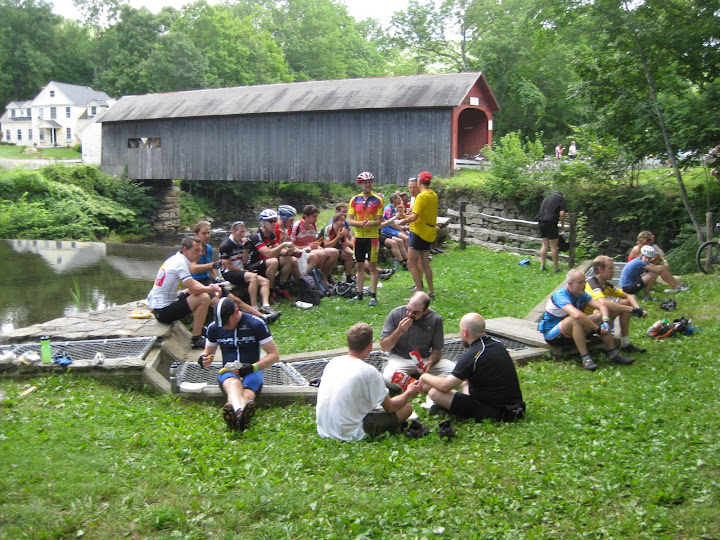
At lunch, next to a covered bridge, we ate baked potatoes and drank what we could. PF trained me long ago to bring my "cytomix" (a blend of Cytomax and a little protein powder). Others drank what was offered at the stop, (grape?) Kool-aid. We thought Gatorade was going to be available, and a couple of our group decided to home-brew the stuff by mixing Kool-aid with the table salt set out for the potatoes. Another rider, unknown to our group, snapped a picture of us here. (I'm standing between the two yellow shirts with sunglasses on my hair while most of the rest of the group is sitting along the river nearby.)

After lunch we rode a delightful flat dirt road along a small river to let the food settle a little, then veered up into the hardest climb of the day. The top part of the hill was the worst: although the dirt transitioned to pavement, the tree cover we had enjoyed suddenly evaporated and we felt the 90 degree sun-baked heat in the utterly windless low-gear grind. But just over the crest, all was well again as we had the view shown in the topmost photo above, and a water stop with fresh produce from the farm there.


SM, above, on a 29er rigid MTB, led us a lot of the time and knew the course perfectly. I'm afraid I over-relied on his guidance, and predictably I noticed this only when I found myself alone and unsure of my location and cue sheet position.

Over the after-ride dinner, the topic of next year's ride was never far from thought. At one point I got into a rant about how I'd like to try the 112mi ride sometime, and it won't get any easier. 'If I could ride it, even just once, it would be the kind of accomplishment that would go on my tombstone!' GC added, 'maybe the same day.' That gave me my biggest laugh of the weekend.

One definition of a good ride is it leaves you inspired for next year's ride. Deerfield was a great success this way, with all of our group discussing route options, bike upgrades and nutrition for next time, starting midway through this ride.

SM took some video and compiled it into a taste of the ride. The video was shot with a hand-held Flip, and I'm impressed he could keep it as steady as he did. Thanks, SM!

For those of us dreaming of the full ride (maybe it's just me?!), a nice blog of the 112mi ride this year was posted by another rider. Sounds inspiring, but also very intimidating!

Honestly, my most ambitious idea is to ride the 112mi route until the lunch stop shared by both routes, then switch to the 65mile route, making a 93mi version. Still, that's probably not sensible unless I can train way better next year. But it would be nice to be on the road starting in the nice cool (and dark) air of the 6AM start the 112-milers get...

Thursday, August 13, 2009

Deerfield Rig


Deerfield is Saturday! A long hilly dirt road ride requires pretty big changes from the road rides I'm familiar with. I'm starting with the Independent Fabrication I've been using as my summer/long-distance bike for years now. It's the Club Racer model, which is designed to accept full fenders, and it does that by using "long reach" brakes, and having good clearance in the frame and fork.

The seatstay gap is 35mm, the limit on tire size. I'm a big fan of Vittoria tires, so for the dirt roads I picked their cyclocross tire, nominally 32mm wide but which measures 30.5mm on my rims. This size perfectly fits, with a little gap for dirt. (This would not work well in mud, and cyclocross bikes have much better clearances for this, but it should suffice here.)

Low gears are important for the hills, including the power loss of loose gravel slipping under the wheels. I favor low gears anyway, to keep my cadence high, so I setup my lowest chainring set, 26 / 42/ 52. But I swapped my 12-27 road cassette for a mountain bike 11-34 cassette to get a really low climbing gear. To do this I had to swap the rear derailleur to a MTB version, including one of the "brifterizer" hacks I build to connect my 10 speed Campy shifters to 9 speed shimano cassettes. The shifting is noisier, benefitting from more nudging than I normally need, but the range is great. (In test rides I found I need to remain seated on a steep loose climb or the wheel will slip - so I'm missing a skill and need extra-low gears to compensate.)

No rear derailleur I know of will handle the full range of gearing described above, so I locked out the large chainring. (The derailleur's bottom pulley moves back and forth as one shifts to take up the slack in the chain for the selected gears. I have a "long-cage" derailleur, able to handle the widest range, but even it has a limit.)

Water is another challenge. While there will be water stops, the organizers are recommending hydropacks so the riders can carry enough water between. I can't imagine wearing that hot thing for a long ride, so my plan is to carry 4 bottles, with 3 on the frame and one in my jersey.

This ride will rely on cue sheets more than any other ride I've ridden. So I added a handlebar bag as a cue sheet holder, but it's a classic touring accessory and I may find I like it.

Excellent Local Bike Shop

In the run up to the Deerfield randonee, my biggest ride of the year, I've been trying to get the bike set up properly and well tested. So I was alarmed to find last night, three days before the ride, that my saddle has cracked. This means not only finding a saddle fast, but I won't have an opportunity to verify the new one is installed properly, with all the fine adjustments critical for comfort on a long ride.

Let's back up a bit over two years to the start of this story. I bought a Specialized Toupe from CycleLoft in Burlington. They have a more liberal return policy than the other shops I know about (which is to say they accept a new-condition return). Around a year later, I found the saddle had cracked, with the effect of making it softer - a very bad thing on long rides. I bought a replacement right away, then later came back with the bad one. They refunded my purchase price on the original one, and said if I'd brought in the bad one, they would have just swapped it for a new one. By this time I believe I was talking to the owner, but I'm not sure. I went on to describe what I see as a design flaw in the saddle, and he mostly agreed, but also said the saddle is designed for people lighter than me. (There's no weight limit on the saddle packaging.) I parted asking whether my new one would hold up, and he said 'worst case you bring it back and get a new one each year. It's an ideal situation'. For me, ideal would be a reliable saddle, but I guess this isn't too bad.

Now return to today. Saddle in hand, I start with a random salesperson who tells me the saddle is more than a year old (so past warranty) and anyway they don't have a match in stock. (Well, they do have white, but I don't like that look. The same out-of-stock issue happened last time and I shifted to a slightly different model.) I didn't argue, but I did ask questions and wound up chatting again with the owner (I think). The three of us searched the store again for the matching saddle which their computer says they have, without luck. Then the owner says they can order the right saddle and in the mean time, he has a Toupe on his own bike which I can borrow! As he was taking apart his bike in front of me in a daze I actually said out loud, "this is like the shirt off your own back". He was saying he wanted a white one on his bike anyway, but I was so amazed that I didn't quite follow how this all works from his point of view.

Bottom line, I'm all set for Deerfield, and in a week or two they'll send me an email* to come pick up my new saddle for free. Where they could have said 'out of warranty; out of luck.' I'm a fan!

Other CycleLoft goodies: 10% off if you're a member of any bike club, and they'll put it in their computer and it becomes automatic forever. Friendly and skilled mechanics (unlike that other bike shop I go to). And my friend DP says they just did a great job servicing his Campagnolo brifter shift discs - work few bike shops will attempt - and they did it for far less than an online shop in CT that I'd figured I'd use when it came time for mine to get serviced.

* email itself is amazing because even this year I've had trouble finding a bike shop that will do email.

Saturday, July 18, 2009

Bumblebee


The new bike is finally together. Unfortunately I haven't really ridden it yet as a stomach bug knocked me out just as our two months of drizzle came to an end. Any day now...

The yellow frame with black parts has become my signature, as well as my favorite of the frame colors. Where I associate the colors with friendly pollinators, A sees Pittsburgh sports teams (Go Steelers, Penguins, etc!) and MF sees the Boston Bruins. I think I'm missing a gene.

(This bike uses one of those new-fangled external bearing bottom brackets. I just don't like it, though it should suffice. I wouldn't put one on a road bike. Next time: ISIS or Octalink.)

Tuesday, July 7, 2009

New Bashguard


I once again cut down a Nashbar bashring to make it smaller and lighter. (The first one was last year.) I took pictures this time. The resulting part weighs 99g, and has a radius 0.15" smaller than the original.

First, cut down the radius. This is the only functional change, adding clearance for rocks.


Next, I drill out some excess metal to lighten the part. The finished hole size is big, 3/8", because small holes don't achieve much savings.


At the end I pared out some excess metal near the edge, using a ball mill at the end to provide a big inside radius to minimize the chance of cracking the aluminum after a big bash.

Wheelbuild, Concluded

I finally finished the wheels last night. Whew! I'm a perpetual beginner/intermediate at this because I go 2-3 years between builds. The bottom line is I'm happy with how they went together and I think they'll serve well, but I've not ridden them yet.

Below is a table of the wheel weights, in case anyone wants to borrow bits of the spec. Note that I strove first for strength and maintainability, using brass nips and mostly (5/8ths) the strongest spoke type. One could build a lighter wheel by giving up some of this longevity.

Bare wheels (no skewers, rotors, cassette): Front = 706g, Rear = 845g. Total 1551g. (This is the number to compare with factory-built wheelsets.)

Full wheels except tires & rim strip: Front = 899g (160mm rotor), Rear = 1319g (140mm rotor, XT cassette).

Rim tape is Stan's yellow tape, claimed 5g per wheel.

Monday, June 29, 2009

Disc Wheel Lacing

I'm building up a new wheel set, my first using disc brakes. These brakes affect the lacing design because the torque applied by the brakes is carried by the spokes to the rim and tire. In contrast, rim brakes (as on most road bikes) apply no torque at all to the spokes.

While I want the wheel set to be strong and reliable, I also want to optimize its weight against the strength required for each part of the wheel. The spokes are a significant part of the weight, and they are available in different thicknesses. I made up a lacing pattern which uses two different spoke thicknesses in different parts of the wheel.

The front wheel has the most complex pattern. The only torque these spokes carry is during braking, so it's all in one direction. I'm using the thinnest spokes in the positions that do not increase in tension when the brake is applied. The thin spokes are also laced inside the hub flanges. The thicker spokes, which carry the brake tension, are laced outside the flanges. This provides a few benefits:
  • When braking, these high-tension spokes are outside the flanges, forming the widest possible bracing angles and therefore the stiffest wheel in terms of resisting side loads.
  • The thicker spokes are the ones furthest from the center plane, so the tip of a stick is more likely to hit a thick, strong spoke instead of a weaker, thin one.
  • The simple rule of thin spokes on the inside of the flange makes them easy to track. The thin spokes must be tensioned more carefully because they can twist or "wind up" more than the thicker ones, and they must be kept untwisted. (I've also marked the thin ones with a pen during the wheel build.)
The rear wheel uses thin spokes only in the same, non-brake-tension position, only on the brake side of the wheel. The drive side (with the cassette gears) has thicker spokes in both directions, to handle both pedalling and brake torques. (I'm treating these hubs as capable of carrying significant torque through the hub shell to the opposite flange, but I consider that torque important only for braking. My pedalling forces can be carried on just the drive side of the rear wheel.)

The main downside to optimizing the lacing this way is complexity. It's easy to put the wrong spoke in a given position. And more spokes need to be purchased and tracked - for example, there are four different spoke sets in the front wheel. (Two thicknesses x a different length for each side.) The rear wheel has three different spoke sets.

I'm rusty enough at wheel building that I made a few mistakes at the beginning, but now both wheels are laced and I've started tensioning the rear. I'm happy with the result so far, and am excited to ride them!

[Notes: The spokes are DT Competition (2.0/1.8mm) and DT Revolution (2.0/1.5mm). All lacings are three-cross (3X). All spoke nips are brass for strength and resistance to corrosion. Hubs are Shimano XTR which are available near half price these days as they seem to be out of favor, and I've had good experiences with my Shimano hubs over many years. I think they're a good value now. Also, I like the loose ball design for hubs because I know how to rebuild and preload them - I'm not excited by the trend toward cartridge bearings. On the other hand, they have the lowest flanges I've seen on a disc hub, so they demand high spoke tension and are probably best for XC-only riding. The rims are Stan's Olympic ZTR, a lightweight and slightly radical offering from a new small manufacturer. I plan to run these wheels tubeless, at least at first, and these rims are designed to work that way or with tubes. Thanks to GC for his great info and experience on these rims.]